

Biodiversity
Biodiversity and nature-related consulting
Disclosure related to biodiversity and nature requires explaining where the company interacts with nature, what impacts occur, and how they are managed. Vosurein, based on GRI 101: Biodiversity 2024 and TNFD, inventories sites, water usage, land, and raw material sources, uses the LEAP method to identify natural dependencies, impacts, risks, and opportunities, and then organizes management measures and disclosure data.

For Your Business
Who this service is for and when to start
Businesses reporting under GRI for which biodiversity is a material topic need to review the relevant disclosure requirements. Those using TNFD or responding to a customer questionnaire on nature should first confirm the scope of the assessment and response. Water withdrawals, discharges and land use in manufacturing, or raw-material sources in food and agriculture, can provide starting points. Activities and location data determine the priorities.
Companies that have not yet established complete data can first select a main site or an important raw material. Confirm the actual factory location, water source, and raw material origin first, which is easier to define follow-up work than collecting a comprehensive questionnaire from all suppliers at once.
If the client has already provided a submission date, please provide a questionnaire or disclosure request at the same time. Preparing sustainability reports, responding to procurement reviews, and establishing internal natural risk management require varying data depths and should be clearly distinguished before launch.
The Challenge
Common challenges faced by businesses
Nature assessments need to establish where activities occur. The same water or land use can have different impacts depending on local water resources, ecosystems and surrounding activities. Company-wide totals alone are often insufficient to set priorities.
For example, knowing an agricultural trader's office address does not identify where a crop was grown. Even for a factory in an industrial zone, the amount of greenery on site does not establish that there are no nature-related risks. Water withdrawals, discharges and raw-material supply must also be considered in relation to the surrounding environment.
Distinguish original records, external data and estimates, retaining the source, year and spatial precision. Do not replace missing data with zeros. Record what cannot be determined, then decide whether to request supplier information, use secondary data or commission a survey.
Our Approach
Methods and applicable requirements
GRI 101: Biodiversity 2024 took effect on 1 January 2026, replacing GRI 304: Biodiversity 2016.It is a Topic Standard, not a requirement for every business to publish a separate biodiversity report. Its use and the applicable disclosures depend on the reporting basis, material-topic assessment and actual impacts.
Conditions for GRI 101:Organisations reporting in accordance with the GRI Standards that identify biodiversity as a material topic must explain how they manage it under GRI 3 Disclosure 3-3, and report the GRI 101 disclosures relevant to their biodiversity impacts. GRI 101 management disclosures supplement rather than replace Disclosure 3-3.
TNFD covers nature-related dependencies, impacts, risks and opportunities. Its four disclosure pillars are governance; strategy; risk and impact management; and metrics and targets. Our consulting uses its LEAP approach: Locate the interface with nature, Evaluate dependencies and impacts, Assess risks and opportunities, and Prepare to respond and report.
Assess dependencies on nature, impacts and risks separately.Dependencies are functions that operations need from nature, such as a reliable water supply. Impacts are changes that business activities cause in nature, such as habitat changes. Risks concern how those relationships may affect operations. The three are connected, but a single score cannot substitute for assessing each.
GRI 101 data work includes policy and management, identification of major biodiversity impacts, location information, direct drivers of biodiversity loss, ecosystem status, and ecosystem services; Genetic resource acquisition and benefit sharing are handled based on whether activities are relevant. TNFD evaluation also needs to return to corporate strategy, risk management, and tracking metrics. The two frameworks can share site and value chain data, but completing one does not mean it complies with the other.
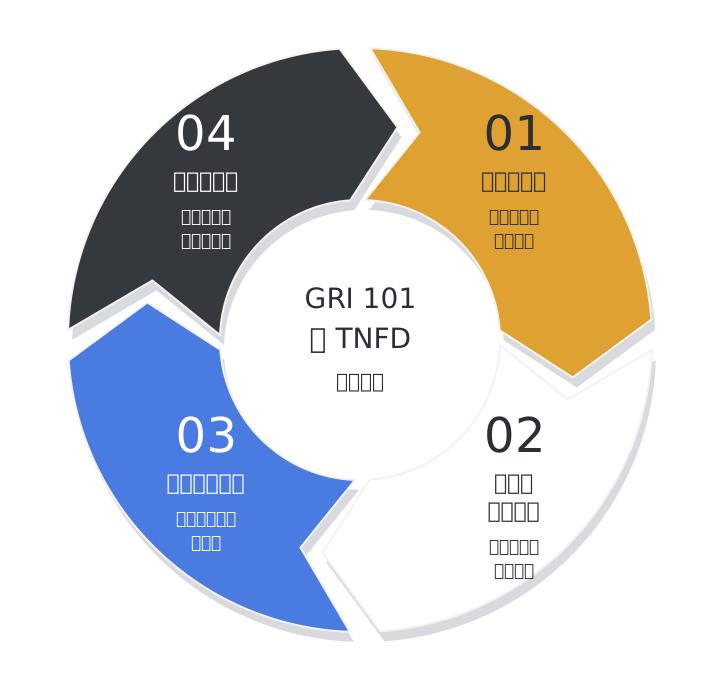
LEAP is an assessment guideline, not a certification, and it does not require every company to perform all work in exactly the same order. The following four stages are Vosurein's collaboration arrangements; When data is insufficient, ecological surveys are involved, or specialized analyses are involved, work boundaries are first confirmed.
Process
Consulting scope and process
Confirm requirements and review available information
Review the links between operations and nature
Confirm why the business is using GRI 101 or TNFD, then map activities and locations across direct operations and the value chain. When reviewing sites, water use, land and key raw materials, distinguish verified origins from locations known only through supplier information. Use this record for subsequent screening.
Identification and prioritization assessment
Identify dependencies on nature and impacts
Identify natural dependencies and impacts by activity and location. Examine how water use, land use, and critical raw materials connect to the local environment, and distinguish between direct operations and value chain information.
Priority issue assessment
Combining location, ecological sensitivity, and operational relevance, select topics that require in-depth evaluation. Record the basis for selection and any parts that cannot yet be determined, avoiding treating preliminary screening as the conclusion of a complete ecological survey.
Management measures planning
Management measures and tracking indicator planning
Agree responsible departments, practical measures and monitoring methods for priority issues. For example, procurement maintains origin traceability, the environmental team updates water-withdrawal, discharge and site records, and the sustainability team compiles evidence for disclosure. Targets need baselines and measurement methods.
Disclosure organization and handover
Disclosure data organization
Compare the assessment results separately with the applicable GRI 101 items and TNFD recommendations, and organize data indexes and disclosure drafts. Incomplete assessments, estimated data, and their limitations will be explained separately from the confirmed results, and then the company will review management commitments, goals, and external disclosure content.
Arrange each stage of work according to company needs and data conditions. The actual scope, division of labor, and review methods should be confirmed by both parties.
Preparation
What documents do companies need to prepare?
GRI 101 and TNFD involve information on location, activities, impacts, and management. For arranging a preliminary assessment, Vosurein organizes data that the company can prepare in advance into the following four categories; this is a way of collecting data, not an official fixed four-category disclosure framework. Missing items can be supplemented after confirming the scope.
- Site and Operations:Site addresses or coordinates, operational activities, land use scope, and existing surrounding ecological or sensitive area information.
- Resource and Environmental Records:Water sources, water intake and consumption data; supplement with existing records of drainage, pollutants, waste, and land use changes according to the nature of activities.
- Raw Materials and Value Chain:Types of key raw materials, purchase quantities and suppliers, and the actual production or origin locations available; include product usage and final disposal information if necessary.
- Management and Disclosure:Existing ecological surveys, policies, management measures and targets, governance responsibilities, risk assessments and stakeholder-engagement records, plus material-topic assessments, sustainability reports or customer questionnaire requirements.
Please annotate data with the year, covered sites, and sources whenever possible. Information not yet obtained will first be recorded as gaps and supplementary methods confirmed; if necessary, secondary data and its limitations will be evaluated. The above is a preparatory checklist for initiating guidance; complete disclosure still requires item-by-item comparison with applicable GRI 101 requirements and TNFD recommendations; when involving confidential or personal information, authorization and provision methods should be confirmed.
Project Planning
Estimating time and cost
GRI 101 and TNFD explain the evaluation and disclosure content, without specifying a fixed duration or fee for consulting services. Vosurein will arrange the work based on the number of sites, the scope of the value chain, the completeness of location data, and the required depth of evaluation. Desktop inventories, tracing sources from suppliers, and on-site ecological surveys all require separate confirmation of workload and professional division.
Vosurein will first confirm the purpose of use, scope of work, and completion deadline, and then propose a cooperation arrangement. Professional surveys, third-party verification, data platforms, and other external costs will be confirmed in the quotation as to whether they are included. If seasonal ecological surveys, responses from overseas suppliers, or external data licensing are required, these should also be included in the schedule.
FAQ
Frequently asked questions
How is biodiversity consulting different from carbon management?
Carbon management focuses on greenhouse gas emissions. Biodiversity and nature assessments also consider site locations, land, water and ecosystems. Existing greenhouse gas inventory data can provide some operational information, but emission reductions alone cannot demonstrate effective nature management.
Is an on-site survey always necessary?
Not necessarily. Preliminary inventories can be conducted using existing data; if ecological condition verification, additional site information, or on-site evidence is needed, an appropriate professional survey can be evaluated. Data inventories and desktop assessments are not equivalent to on-site ecological surveys and cannot replace environmental impact assessments.
How to include the supply chain?
First, select key raw materials and supply relationships, confirm which source locations can be traced, and then evaluate related nature issues. If only supplier addresses can be obtained without confirming the actual origin, this limitation will be recorded and further data enhancement methods discussed.
How do GRI 101 and TNFD complement each other?
GRI 101 focuses on corporate biodiversity impacts and management disclosures; TNFD covers nature dependencies, impacts, risks, and opportunities, linking governance, strategy, and financial planning. Vosurein uses LEAP to assist evaluation, then maps applicable data to the disclosure requirements of both to reduce duplicate compilation. The scope and requirements still differ; completing one set of disclosures does not automatically comply with the other.
Can data from GRI 304 still be used in 2026?
Existing data can be retained but must be rechecked against the applicable disclosure items in GRI 101. Site area or protected area information from old forms may not be sufficient to meet new requirements on management, impact location, and ecosystem status. First, perform a gap analysis and then decide which data to supplement.
Is TNFD mandatory certification?
TNFD recommends providing an assessment and disclosure framework for nature-related dependencies, impacts, risks, and opportunities, but it is not a certification system itself. Whether a company has mandatory reporting obligations should be separately confirmed by local regulations, exchange regulations, or customer contracts; Adoption of TNFD does not mean obtaining certification.
Can tree planting or ecological activities be directly recognized as natural management achievements?
Keep records of the activities, but also explain their relationship to the business's significant impacts on nature, their locations, management methods and monitoring results. Tree counts or spending alone cannot show whether existing impacts have decreased or overall biodiversity has improved.
Related
Related services and enquiries
Please provide the industry, actual needs, applicable year, and estimated completion date to facilitate discussion of the scope of cooperation.Consult with Vosurein
Content checked: . Applicable versions and requirements depend on the company’s circumstances.
Let's Talk
Start a conversation about your needs.
Tell us how the work is done today and when you hope to finish,
so we can agree the scope and way of working together.

Blog
Sustainability and AI insights
Start with understanding,
and see where change can lead.