
Product Carbon Footprint
Product carbon footprint support
Product carbon footprint analysis quantifies greenhouse gas emissions and removals for a defined product unit and life cycle boundary. Vosurein uses data on the product’s intended use, materials and processes to build a calculation model and identify the main emission sources. This helps companies explain the results to customers and assess changes to materials, energy or transport.
For Your Business
Who this service is for and when to start
Start planning a product carbon footprint study when a customer requests product emissions data, when preparing for verification, or when comparing designs and materials. Collecting data before developing a new product or changing suppliers reduces the need to retrieve records after mass production starts.
First establish how the results will be used. Internal improvements, customer procurement, label applications and public comparisons may require different levels of detail. If there are many product models, assess whether representative products can be studied first. Applying their results to other models still requires a documented basis for grouping and extrapolation.
The Challenge
Common challenges faced by businesses
A bill of materials (BOM) lists design quantities, but actual production involves material losses, yield differences and variations between batches. Factory energy bills may cover several production lines. Without reconciling these records, a calculated footprint total may not clearly represent a particular product or set of production conditions.
The use and end-of-life stages also require reasonable assumptions. Results depend on factors such as the service life, use frequency and location of energy-consuming products, as well as recycled content and the source of emission factors. The study distinguishes assumptions from site records and examines the effect of changes to key assumptions.
Public comparisons require an additional check. Two results expressed in kilograms of CO₂e may still reflect different product functions, boundaries and methods. We check whether the results are comparable before drawing conclusions about a product’s performance from the totals.
Our Approach
Methods and applicable requirements
ISO 14067:2018 sets requirements for quantifying and reporting full and partial product carbon footprints, following life cycle assessment principles. A study first defines the functional or declared unit, system boundary and applicable product category rules (PCR). It then compiles the life cycle inventory, quantifies climate change impacts and interprets the results.
The scope is determined by the intended use of the results. A complete life cycle may cover raw material acquisition, manufacturing, transportation, use, and end-of-life; if the study only goes up to the factory gate, the report must clearly state it is a partial carbon footprint. The settings for the use and disposal stages are determined according to product characteristics and applicable rules.
Quantification and public claims are handled separately: ISO 14067 addresses climate change, not other environmental, social or economic impacts. Carbon offsetting and communication of carbon footprint information are also outside its scope. After the study, any label application or product claim must therefore be checked against the requirements for that use.
The GHG Protocol Product Standard also provides a method for product life cycle accounting. Its suitability depends on customer and study requirements. Where products share a production line, we first assess whether separate measurements or process subdivision are possible. If allocation is needed, we select a method supported by the applicable rules and document the reasons. The interpretation includes data limitations and key assumptions so customers can understand the results and the company can assess improvements.
In 2026, GHG Protocol and ISO are jointly developing a product-level accounting standard. Studies continue to follow the applicable ISO 14067:2018 requirements or customer-specified rules. We record the version used and assess the implications of future updates.
Process
Consulting scope and process
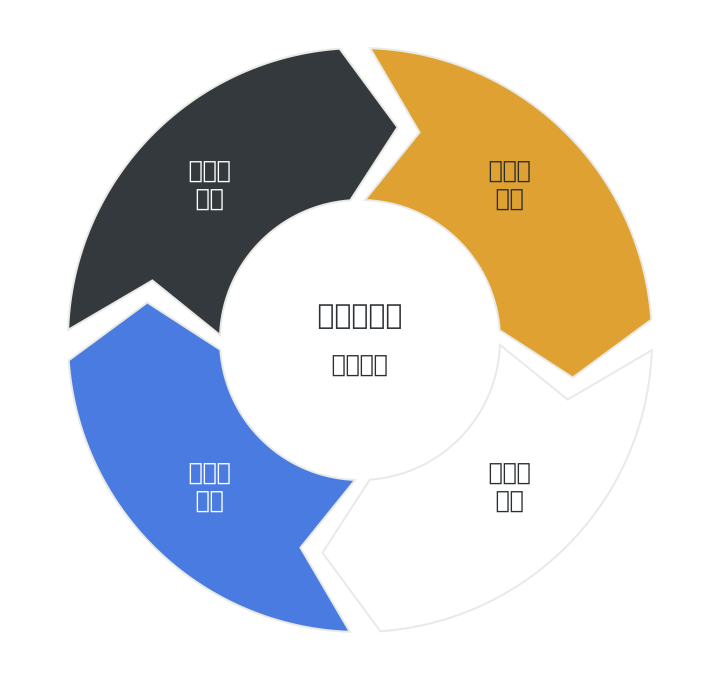
Confirmation of purpose, unit, and boundaries
Start with the product model and intended use of the results. Confirm the functional or declared unit, applicable rules and life cycle stages. Document the boundary, assumptions and data period before collecting data.
Review life-cycle data
Reconcile the BOM with actual material inputs, process, packaging and transport records. Plan how to account for shared energy use and collect upstream data. When using secondary data, check whether its year, geography and technology are representative of the product being studied.
Carbon footprint calculation and emission hotspot review
Check material flows, units and allocation methods so the calculations can be traced back to their inputs. Alongside the total, identify the main emission sources at each life cycle stage and assess how key assumptions affect the results. Use these findings to discuss improvement options.
Reporting and improvement coordination
Organize results, methods, data quality, and limitations into a research report to assist with review and verification preparation. Discuss improvement directions based on emission sources and confirm which data needs to be updated after product or process changes.
Preparation
What documents do companies need to prepare?
Start with existing files for these four data categories. We can then check their reporting periods and units together:
- Product and requirements: Model, specifications, functions and intended use, customer requirements, and existing PCR, verification, or labeling rules.
- Materials and processes: BOM, actual material inputs, production volumes, yields, process diagrams and packaging data. Indicate whether equipment is shared by multiple products.
- Energy and logistics: Electricity and fuel use, transport weights and distances, and applicable assumptions about product service life, use patterns and end-of-life treatment.
- Emission factors and evidence: Supplier data, database and emission factor versions, original records, previous studies and verification opinions.
Distinguish site measurements, supplier data and estimates. Where data is missing, we explain how to address the gaps and how they limit the results. Assumptions are not presented as measured values.
Project Planning
Estimating time and cost
Use the BOM, process diagram and study boundary of a representative product to assess complexity before estimating the work across all models. Besides the number of products, material types, allocation across shared production lines, supplier responses and use-stage scenarios affect the time needed for data collection and calculations.
The agreed scope covers the study, report, review and verification preparation, with time allowed for collecting data and missing documents. External costs, such as database licences, third-party verification and label applications, are confirmed separately.
FAQ
Frequently asked questions
How does a product carbon footprint differ from an organizational greenhouse gas inventory?
An organizational inventory covers emissions within an organizational boundary over a reporting year. A product carbon footprint covers a defined product unit and its life cycle. Factory energy data can be used as an input, but allocation and upstream and downstream product data must also be addressed.
How should functional units and declared units be chosen?
The functional unit should describe the function and performance conditions provided by the product; the declared unit is the amount of product declared by the study. It should be confirmed according to purpose, study boundaries, and applicable PCR, and cannot be arbitrarily changed just to obtain a lower value.
Can we proceed if suppliers have no carbon footprint data?
Suitable secondary data may be used after assessing its relevance, with sources and limitations documented. Prioritize data quality improvements for key materials. If customers or the applicable PCR require more detailed data, those requirements must also be met.
Is ISO 14067 verification equivalent to obtaining a carbon label?
No. Carbon footprint verification is separate from a label scheme’s application, review and conditions of use. Check the rules of the scheme you intend to use.
Can we claim that our product has a lower carbon footprint than a competitor’s?
Comparing two totals is not enough. First check whether the product functions, boundaries, methods and data quality are comparable and whether applicable comparison requirements are met. Review the evidence supporting any public claim.
Can product carbon footprint be used as CBAM data?
Some basic data can be reused, but the range of goods and the method for embedded emissions in CBAM are different. A separate comparison should be made, and the carbon footprint report should not be directly regarded as CBAM compliance documentation.
If a production line has multiple products, how should electricity be allocated?
First look for submeter readings, machine operating hours or process activity data that reflect each product’s actual energy use. Where allocation is necessary, choose a justified method based on applicable rules and product characteristics. Keep the calculations and reasons for the choice, rather than dividing total factory electricity equally among all models.
After changing raw materials or modifying the process, should the calculation be redone?
The impact of the change on the representativeness of the existing study, as well as updates required by customers, PCR, or the labeling system, should first be assessed. When important raw material sources, quantities, energy mix, or processes change, relevant data and calculations usually need to be updated; the old numbers cannot be used unconditionally.
Related
Related services and enquiries
Please provide the product model, intended use, BOM and life cycle boundary requested by the customer. Include any PCR, verification or label requirements.Consult with Vosurein
Content checked: . Applicable versions and requirements depend on the company’s circumstances.
Let's Talk
Start a conversation about your needs.
Tell us how the work is done today and when you hope to finish,
so we can agree the scope and way of working together.

Blog
Sustainability and AI insights
Start with understanding,
and see where change can lead.