

GHG Protocol
Organizational GHG inventory support (GHG Protocol)
A corporate greenhouse gas inventory answers three questions: which entities and sites are included, which activities produce emissions, and where each figure comes from. Vosurein helps organise Scope 1, Scope 2 and applicable Scope 3 emissions under the GHG Protocol, building an inventory that can be updated annually for customer responses, reduction targets and disclosures.
For Your Business
Who this service is for and when to start
Businesses can plan an inventory when customers request carbon data, when preparing CDP responses or SBTi targets, or when consolidating group emissions. Businesses with an existing inventory should review their boundaries and methods when adding sites, undergoing mergers or acquisitions, or extending value-chain coverage.
Before starting, confirm who will use the report, the reporting year and the required scopes. If the data will also support statutory reporting in Taiwan or other specified disclosures, check those requirements separately. A voluntary inventory may not meet every statutory reporting requirement.
The Challenge
Common challenges faced by businesses
Emissions data sits across departments: facilities staff hold energy bills, HR has commuting data, procurement holds supplier and material information, and finance keeps transaction records. Inconsistent periods or units can cause double counting or omissions even when all records are available.
Records also need interpretation. Refrigerant purchases do not necessarily equal annual leakage; replenishment, recovery and stocks must also be considered. Before estimating emissions from travel expenditure, check the transport activities and available data. Identify the activity each record represents before selecting a method.
Scope 3 also requires attention to supplier data quality and estimates. Consulting reviews each category, identifies significant emissions sources and gaps, then prioritises improvements. Keep a record of which figures use original activity data and which rely on secondary data.
Our Approach
Methods and applicable requirements
The GHG Protocol Corporate Standard provides the basis for an organisational emissions inventory, supplemented by the Scope 2 Guidance for purchased energy and the Scope 3 Standard for the value chain. Select the organisational boundary and reporting year before calculation. Consolidation can follow the equity share or control approach; control may be financial or operational. Apply the selected approach consistently.
Scope 1 deals with direct emissions from sources owned or controlled by the company; Scope 2 deals with indirect emissions caused by obtaining electricity, steam, heat, or cooling; Other upstream and downstream activities are evaluated item by item according to the 15 categories in Scope 3. How leasing plants, vehicles, or outsourced activities are classified must be determined together with control relationships and applicable methods.
Scope 2 dual reporting:Businesses operating in markets that provide product- or supplier-specific contractual instruments must calculate and report both location-based and market-based results. Contractual instruments used for the market-based method must meet the quality criteria. Consulting checks the period, coverage and evidence for energy purchases and contracts before applying them to emissions calculations.
Scope 3 can use primary or secondary data depending on the category and data conditions. Calculation records will retain activity data, factors, and Global Warming Potential (GWP) versions, explaining estimates, exclusions, and data quality; information that requires separate handling, such as biomass sources, will also be presented according to applicable requirements. In addition to total amounts, the annual report must explain organizational and operational changes and have a consistent base year recalculation policy.
GHG Protocol and ISO are jointly developing an integrated corporate carbon accounting standard, currently scheduled for release in the fourth quarter of 2028. Continue preparing inventories under applicable current rules, retaining method and data versions for future adjustments.
Process
Consulting scope and process
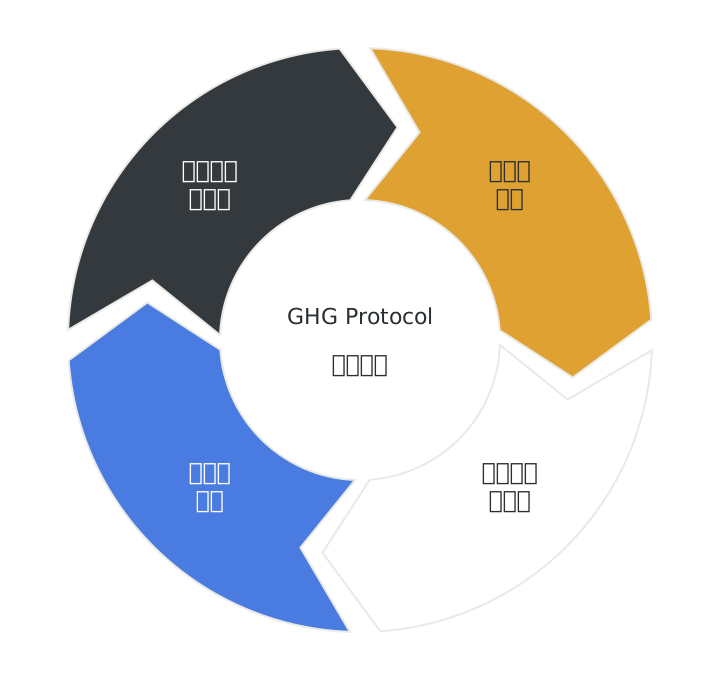
Purpose and Boundary Setting
Compare with the company structure, sites, and control relationships to confirm reporting purpose, inventory year, and consolidation method. Record the judgments of inclusion and exclusion so that each department knows the scope of this data collection.
Emission Sources and Data Collection
Review direct emissions, purchased energy and value-chain activities, and assign data providers. Organise original bills and operating records by period. For missing data, identify the additional records needed or the estimation method to use.
Calculation Checks and Hotspot Analysis
Verify activity data, factors, and unit conversions, check scope classification and double counting. Then compare annual results with production, site changes, etc., to identify major emission sources and differences that need explanation.
Reporting and Annual Management
Prepare the inventory, methods and supporting evidence for internal review and verification. Document annual updates, data checks and the base year recalculation policy so the work can continue in the following year.
Preparation
What documents do companies need to prepare?
Provide existing records by activity and the department that holds them, then organise them into consistent fields:
- Organization and Year:Company and group structure, ownership and control relationships, domestic and international sites, inventory year, and reporting purpose.
- Direct Emissions and Energy:Fuel use, refrigerant replenishment and recovery, process and vehicle records, and data on purchased electricity, steam, heat, and cooling.
- Value Chain Activities:Applicable data on procurement, capital equipment, logistics, waste, business travel, commuting, and product use, with data sources noted.
- Existing Management and Evidence:Previous inventories, calculation methods and emission-factor versions, energy contracts, verification findings and records of organisational changes.
Please keep the original unit, period, and providing department. If there is no actual supplier test data, you can first check whether the secondary data is applicable, record representativeness, and subsequent improvement items.
Project Planning
Estimating time and cost
Distinguish an initial inventory from an annual update. The first inventory requires identifying emissions sources, boundaries and data fields. Annual updates focus on changes in data, error correction and quality improvement. Neither workload can be assessed by employee numbers alone.
Estimates consider the sites, reporting years and number of Scope 3 categories, then assess the work for data export, training, calculations and reporting. Allow time for company submissions, internal reviews and responses to verification queries. Confirm third-party verification fees separately.
FAQ
Frequently asked questions
Is the GHG Protocol the same as ISO 14064-1?
Both support organisational greenhouse gas accounting, but their structures, classifications and applicable requirements must be compared individually. An inventory prepared under one can provide some reusable data for the other; changing the cover alone does not establish conformity.
Is it mandatory for every supplier to provide emission values for Scope 3?
Not necessarily. Different methods can be used depending on category, data quality, and purpose. Initially, secondary data can be used to filter hotspots, then prioritize improving key suppliers' activity and emission information.
Does completing an inventory mean emissions have been reduced?
No. An inventory establishes an emissions baseline. Reductions require action and ongoing tracking, distinguishing the effects of production changes, boundary adjustments and actual efficiency improvements.
Can carbon credits be directly deducted from the total emissions in the inventory?
Carbon credit trading should not be directly offset against the total emissions inventory. Relevant reduction or offset information should be presented separately according to applicable requirements to maintain comparability of emission figures.
Does completing consulting mean verification has been passed?
No. Consulting helps prepare methods, data and supporting evidence. A third party independently conducts verification and reaches its own conclusion. The company must address any findings.
Can we choose just one of the location-based and market-based methods?
Under the Scope 2 Guidance, companies operating in markets that provide product- or supplier-specific data through contractual instruments must report both location-based and market-based results. Instruments used for the market-based method must meet the quality criteria. Check the market and energy procurement records for each site to establish how the requirements apply.
If a company merges or sells a factory, should the numbers from the previous year be recalculated?
It should be assessed according to the pre-established base year recalculation policy and materiality threshold. Changes in structure, methods, or significant errors may require recalculation; simple growth or decline in production should not automatically be considered a reason for recalculation. The reason for recalculation and its impact on the numbers should be documented.
Related
Related services and enquiries
Please provide the number of sites, the inventory year, the Scope 1/2/3 coverage you wish to include, and the purpose of the report, to facilitate confirmation of data collection and calculation arrangements.Consult with Vosurein
Content checked: . Applicable versions and requirements depend on the company’s circumstances.
Let's Talk
Start a conversation about your needs.
Tell us how the work is done today and when you hope to finish,
so we can agree the scope and way of working together.


Blog
Sustainability and AI insights
Start with understanding,
and see where change can lead.