

GRI
GRI sustainability reporting support
GRI sustainability reports explain a company’s significant impacts on the economy, the environment, and people, as well as how these are responsibly managed. Vosurein assists companies in confirming the reporting scope, identifying material topics, compiling indicators and management records, completing drafting, content indexing, and pre-publication review. Work starts with data and judgment, enabling readers to understand what the company experienced, what measures were taken, and which issues are still pending.
For Your Business
Who this service is for and when to start
For companies preparing a report for the first time, it is recommended to confirm the included companies, operational activities, reporting period, and expected release date before departments begin collecting data. If the client has additional questionnaires or specified disclosure items, they can be included in the data requirements to reduce repeated submissions later.
For companies with existing reports, it is necessary to review whether new sites have been added, business changes occurred, significant events happened, or standards have been updated in the current period. Material topics and data scope need to reflect current operations and cannot just reuse sections and data fields from the previous year.
When preparing IFRS S1/S2 disclosures alongside a GRI report, share source data, responsible contacts and review records where possible. Assess impact materiality and sustainability-related financial information separately. Different reporting purposes require separate decisions about which information to include.
The Challenge
Common challenges faced by businesses
If material topics are merely copied from peers, companies often cannot explain why a particular topic was included or excluded. Questionnaires can provide stakeholder opinions, but they must also be compared with operations, business relationships, and known impacts, leaving an explainable judgment process.
Data issues usually occur in scope and definition. For example, a certain indicator covers the entire company while another only tracks the factory, yet both are labeled as group performance; or the calculation method is adjusted this period without explaining the limitations for comparison with previous periods. These data verification situations require clarification from the source unit before deciding how to present the data and text.
The report also needs to explain management shortcomings. Incomplete measures, unmet goals, and significant events should be presented according to applicable requirements to reflect the actual situation and explain follow-up actions; activity photos or commitment statements are not enough to demonstrate whether measures are effective.
Our Approach
Methods and applicable requirements
GRI has three sets of standards: Universal Standards set common requirements, Sector Standards identify potentially material topics for an industry, and Topic Standards specify relevant disclosures. GRI 1: Foundation, GRI 2: General Disclosures and GRI 3: Material Topics establish the basis for deciding what applies before preparing indicators and narrative disclosures.
Determining material topics.According to GRI 3, negative impacts that have occurred are assessed based on severity; for potential negative impacts that have not yet occurred, the likelihood of occurrence must also be considered. Severity includes scale, scope, and irremediability; when it involves potential adverse human rights impacts, severity takes precedence over likelihood. Vosurein collates operational and engagement data based on this to help companies keep records of assessment, prioritization, and approval.
Report statements and disclosure levels.To claim "reported in accordance with GRI Standards" (in accordance), all relevant requirements of GRI 1 must be completed. If only some information is used, it can be handled under the "reported with reference to GRI Standards" (with reference) requirements, but the statement, content index, and notification to GRI are still necessary. Whether missing data can be omitted and how to explain it should be checked against applicable conditions one by one.
Transition for the 2026/2027 versions.GRI 101: Biodiversity 2024 took effect on 1 January 2026. GRI 102: Climate Change 2025 and GRI 103: Energy 2025 take effect on 1 January 2027. Prepare data according to publication timing, applicable topics and adoption plans, and check related Sector Standard updates. These new editions of 101, 102 and 103 are Topic Standards, not the former Universal Standards with the same numbers.
For each material topic, the report connects impacts, policy commitments, actions and performance tracking. Where a relevant Sector Standard has been published, the company must use it to consider potentially material topics and retain the reasons for its decisions.
Process
Consulting scope and process
Review reporting scope and applicable standards
List the reporting entities, operational activities, reporting period, and publication dates, and confirm the applicable guidelines and existing data. Agree with the company on departmental contacts, data formats, and approval checkpoints, and first address inconsistencies in scope or unsettled data.
Impact identification and material topics
Organize operational and business relationship records, events, stakeholder and expert opinions to identify actual and potential impacts. Assist in recording the reasoning for assessment and prioritization to form a list of material topics, then confirm management responsibility and disclosure requirements for each topic.
Data integration and report writing
Check the reporting period, scope, units, calculation methods, and original sources of each indicator, and clarify matters regarding previous comparisons and restatements. When writing, separate policy, implementation, performance, and work yet to be completed, and have the data units verify the facts.
Index check and publication preparation
Use the GRI content index to check disclosure locations, use statements, and applicable omission explanations, and verify cross-chapter data and page numbers. Assist the company in completing reviews, notifying GRI, and preparing agreed assurance data, hand over source files, and subsequent updating responsibilities.
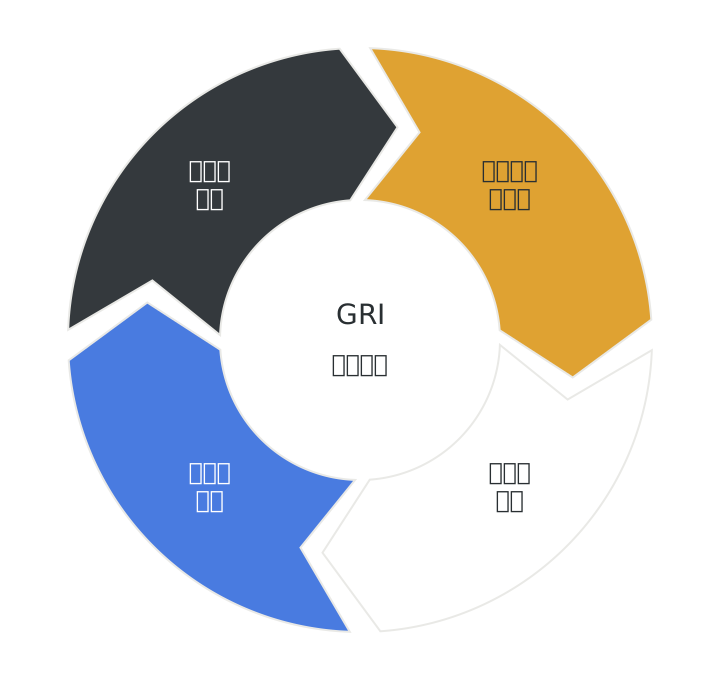
Preparation
What documents do companies need to prepare?
- Organization and reporting scope:Included companies, organizational structure, operational activities and sites, reporting period, expected publication date, as well as existing reports and changes in scope this period.
- Impacts and engagement:Impact or risk assessments, significant events and complaints, stakeholder communications, expert opinions, and previous material topic judgment records.
- Systems and execution:Governance and management responsibilities, policy commitments, operational procedures, action plans, and the implementation progress of each material topic.
- Indicators and evidence:Applicable environmental, personnel, occupational safety, and procurement data, along with scope, calculation methods, original sources, previous comparisons, and review records.
This is the initial project list, and actual requirements will be adjusted according to material topics and applicable guidelines. Providing existing data first and noting any gaps is more helpful for determining subsequent work than writing a paragraph without sources.
Project Planning
Estimating time and cost
To estimate the work, review the reporting entities and material topics, whether data definitions are consistent, and whether further stakeholder engagement is needed. Include time for translation, conversion or scope checks where information spans countries or multiple sites.
Data collection, initial draft, departmental review, and approval for publication each have their sequence. If the data is still being finalized, major topics are being adjusted, or waiting for external assurance, these conditions must be incorporated into the scheduling of the publication date.
Quotations will distinguish the scope of content preparation, design, translation, printing, and assurance collaboration. You can first provide the previous version of the report, the scheduled publication month, and changes in the current period, and then discuss which tasks need to be completed; the number of pages in the report does not by itself represent disclosure quality.
FAQ
Frequently asked questions
Is it necessary to create a materiality matrix for a GRI report?
The key is to identify significant impacts and explain the process for determining material topics. The matrix can be used for communication but cannot replace impact analysis with only survey scores or charts.
Does every GRI topic standard need to be disclosed?
No. Disclosures should be confirmed according to universal standards, applicable industry standards, and material topics, without treating all indicators as a fixed list for every company.
Can preparation start even if the data is incomplete?
You can begin by reviewing available information and assigning responsibilities. Whether information may be omitted, and how to explain an omission, depends on the applicable requirements. Missing data does not automatically exempt a business from disclosure.
Can GRI and IFRS S1/S2 share data?
Some sources and management records can be shared, but the disclosure purposes and materiality assessments are different for the two. Completing a GRI report does not mean compliance with IFRS sustainability disclosure standards.
Will GRI certification be obtained upon completion of preparation?
This service is report preparation and review guidance, and does not issue GRI certification. External assurance, official report support services, and the company’s standards usage declaration are different matters and should be confirmed separately.
How does reporting in accordance with GRI differ from reporting with reference to GRI?
Reporting in accordance with the GRI Standards requires meeting all relevant reporting requirements. Reporting with reference to them can cover selected GRI information, but still requires a statement of use, a content index and notification to GRI. Choose the statement after checking the report; reporting with reference must not be presented as reporting in accordance.
For data from 2026 and the report published in 2027, what updates should be noted?
GRI 102: Climate Change 2025 and GRI 103: Energy 2025 take effect on 1 January 2027. Plan editions around the publication date of the information. If climate or energy is a material topic, review the new data requirements early and check related Sector Standard updates. Changing the year on the cover is not enough.
Does GRI mandate external assurance?
GRI recommends enhancing information credibility through external assurance, but external assurance is not a universal requirement under GRI. Companies still need to confirm applicable local regulations, stock exchange or customer requirements, and the applicable scope of assurance.
Related
Related services and enquiries
Please provide the reporting entity, previous version of the report, release time, and whether design, translation, or assurance collaboration is needed, to facilitate confirmation of the preparation scope.Consult with Vosurein
Content checked: . Applicable versions and requirements depend on the company’s circumstances.
Let's Talk
Start a conversation about your needs.
Tell us how the work is done today and when you hope to finish,
so we can agree the scope and way of working together.


Blog
Sustainability and AI insights
Start with understanding,
and see where change can lead.