

IFRS S1/S2
IFRS S1 / S2 sustainability- and climate-related financial disclosures
IFRS S1/S2 require companies to explain sustainability-related risks and opportunities that could affect their prospects, so investors, lenders and other creditors can understand the links to operations and finances. Vosurein starts by confirming the applicable reporting year and reporting boundary, then helps identify material topics, carry out climate scenario analysis and prepare data for the annual report sustainability chapter. Scenario analysis focuses on changes in risk and their operational effects. Monetary estimates and accounting judgements are provided by the company’s finance team or separately appointed specialists.
For Your Business
Who this service is for and when to start
Taiwan’s TWSE- and TPEx-listed companies adopt the standards in three phases based on paid-in capital. The table distinguishes the financial year covered by the data from the following year in which the information is filed. A first filing in 2027 covers 2026 data, so preparation starts before 2027.
| Paid-in capital of TWSE- and TPEx-listed companies | First applicable accounting year | First filing year |
|---|---|---|
| TWD 10 billion or more | Year 2026 (R.O.C. year 115) | Year 2027 |
| TWD 5 billion to less than TWD 10 billion | Year 2027 (Republic of China Year 116) | Year 2028 |
| Less than TWD 5 billion | Year 2028 (Republic of China Year 117) | Year 2029 |
The third phase applies below TWD 5 billion; exactly TWD 5 billion falls in the second phase. For companies with no-par shares or a par value other than TWD 10, the rules use net-worth thresholds of TWD 20 billion and TWD 10 billion for the first two phases. Financial institutions and special cases must check their sector-specific rules rather than apply this table automatically.
Companies in the first phase must collect and review their 2026 data during that year. Companies adopting in 2027 should track preparation against their implementation plans, report progress to the board quarterly, and trial materiality assessments, scenario analysis and links to financial data. Unlisted companies may also adopt the standards to meet group, financing or customer needs, after confirming those needs. They are not all subject to the same mandatory timetable.
The Challenge
Common challenges faced by businesses
The standard focuses on information that has a material impact on the business. Simply listing names of high temperature, carbon pricing, or supply chain risks is still insufficient to explain their relationship with business models, strategies, and financial planning. Companies with existing TCFD or sustainability reports may continue to use substantiated content and then verify the reporting entity, period, and materiality judgments.
Common gaps include using different assumptions between finance and sustainability departments, listing only risk names without impact pathways, and emission data not covering the applicable consolidation scope. Companies may also have carbon reduction measures but fail to record the resources invested, progress, and target measurement methods.
Using high temperature at a factory as an example, temperature changes alone cannot explain business risk. It is necessary to confirm cooling demand, operational restrictions, and existing protections before discussing which operational activities may be affected. Scenario charts should record the data source, base period, spatial resolution, and scoring method; a single risk score cannot be directly considered as the expected loss amount.
Our Approach
Methods and applicable requirements
IFRS S1 stipulates general requirements for sustainability-related financial information, focusing on risks and opportunities reasonably expected to affect a company's short-, medium-, and long-term cash flows, financing availability, or cost of capital. Materiality must consider whether information affects the decisions of investors, lenders, and other creditors; general ESG questionnaire rankings cannot be used as a substitute.
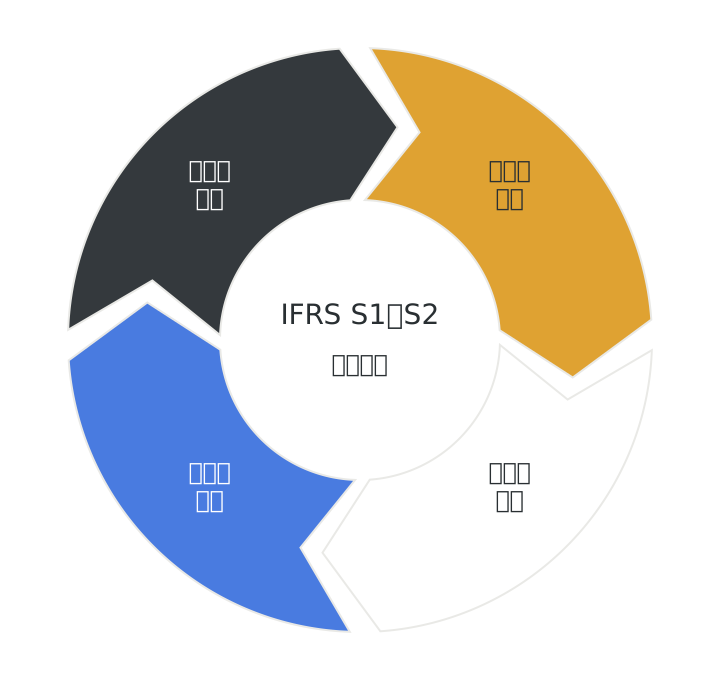
IFRS S2 focuses on climate-related physical risks, transition risks, and opportunities, to be used in conjunction with S1. Disclosures are organized around four core areas: governance, strategy, risk management, and metrics and targets; assessments must also take into account applicable industry information. S1 requires reference to and consideration of the applicability of SASB disclosure topics; industry metrics in S2 must refer to and consider their industry-specific guidance, rather than filling in all industry metrics one by one.
Governance explains oversight responsibilities and management roles; strategy describes how risks affect the business model and decision-making; risk management lays out identification, assessment, prioritization, and tracking procedures; metrics and targets present measurement methods, results, and progress. S2 does not require every company to first establish a transition plan, but adopted transition plans and related material information must be disclosed as required.
Taiwanese companies should follow local laws and FSC-endorsed standards. The ISSB issued amendments to S2 greenhouse gas disclosures in December 2025, effective internationally for annual periods beginning on or after 1 January 2027. The FSC endorsed them in April 2026, permitting early adoption from 1 January 2026 with disclosure of that choice. Consulting records the version used and any applicable reliefs.
Process
Consulting scope and process
Review applicability and materiality
First, verify the alignment stage, reporting entity, and reporting period, then review which disclosures can be supported by existing annual reports, TCFD, GRI, and inventory data. Sustainability chapters for applicable Taiwanese companies must complete board approval and statutory filing procedures, so the work plan separates management review, board deliberation, and filing timelines.
Combine industry, business model, and value chain to help identify sustainability risks and opportunities, summarize materiality judgments, and pathways of short-, medium-, and long-term impacts. For example, supply disruptions or changes in raw material or energy costs and how these link to revenue, costs, and asset utilization; actual issues should be confirmed based on company facts.
Climate Resilience and Scenario Analysis
First, identify main locations, operations, and assessment issues, then select scenarios, baseline period, future periods, and climate indicators. Physical risks can be analyzed for hazards such as high temperatures, rainfall, and water scarcity; if a company is affected by policy, energy, demand, or technological changes, relevant transition risks must also be included and not just weather at the plant site.
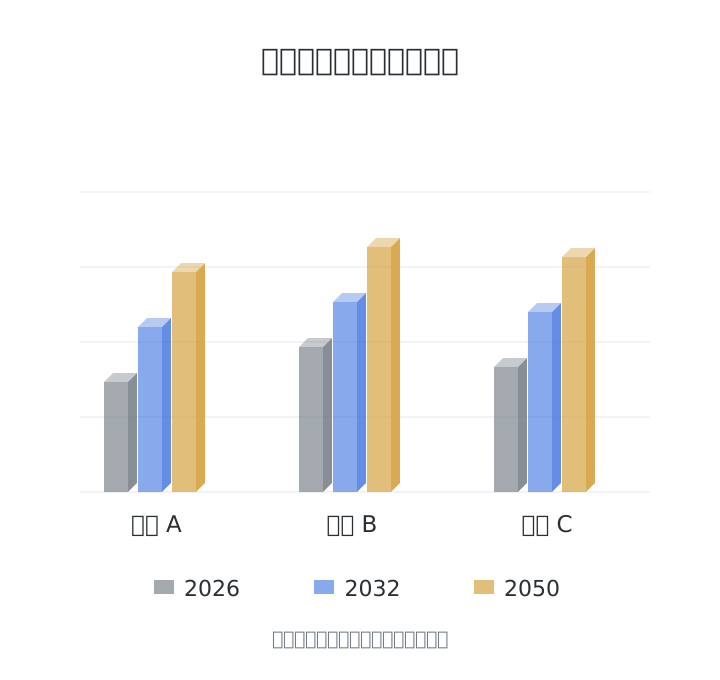
Depending on the available data, prepare trend charts, grouped bar charts, radar charts or site risk maps. Record why scenarios were selected, data limitations and potential operational impacts. SSP5-8.5 is one possible scenario; S2 does not prescribe it as the sole scenario or require every combination of SSP and radiative forcing level.
S2 requires scenario analysis to support a climate resilience assessment. Qualitative, quantitative or mixed methods must be proportionate to risk exposure, skills and resources. This service does not include models of asset losses, revenue or cash flow amounts unless separately agreed.
Metrics and financial impact
We help organize emissions, energy and target data, together with financial information already prepared by the company, identifying data owners, sources and gaps. S2’s cross-industry metrics cover more than emissions. They also include applicable information on assets or activities exposed to physical and transition risks, climate-related opportunities, capital deployment, internal carbon pricing and links to remuneration.
The standards require disclosure of current and anticipated financial effects. That obligation is assessed separately from the scope of this scenario analysis service. Vosurein helps map operational effects and disclosure gaps; the company’s finance team or separately appointed specialists provide monetary estimates and accounting judgements. When conditions for relief from quantitative disclosure are met, the company must still explain why, describe the qualitative effects and relevant financial statement items, and assess combined financial effects as required. Missing data should not simply be entered as zero.
Disclosure controls and handover
We help prepare a draft sustainability chapter, data index and review records, checking that periods, assumptions and figures agree with financial information. The company approves governance and financial conclusions. Qualified assurance providers handle any independent assurance separately; consulting does not itself constitute an assurance opinion.
The work at each stage depends on available data and the agreed scope. Model development, cross-border data consolidation, complete GHG inventories and independent assurance are defined separately before the engagement.
Preparation
What documents do companies need to prepare?
- Company and reporting: Listing status, paid-in capital, organizational and consolidation boundaries, reporting year, annual reports and existing sustainability disclosures.
- Governance and Operations: Board and management responsibilities, risk lists, key sites and supply relationships, business strategies and transition measures.
- Climate and metrics: Greenhouse gas inventory and assurance data, energy usage records, climate risk analysis, scenario assumptions, and target tracking.
- Finance and Evidence: Relevant financial reports, budgets and capital expenditure plans, information on assets, revenue and costs, calculation methods and departmental review records.
The above list is for initiating guidance and is not a complete list of all disclosure items in the standards. For preliminary inquiries, companies can first provide the applicable year, industry, consolidation scope, and reporting arrangements, and then supplement the information according to actual risks. Estimated information, information pending approval, and information with original evidence should be separately marked to avoid mixing during consolidation.
Project Planning
Estimating time and cost
The workload depends on the number of consolidated entities, distribution of sites, existing disclosure maturity, as well as the number of scenarios, periods, and hazard indicators. Scenario analysis that requires organizing overseas sites, obtaining climate data at different resolutions, or tracing supply chain locations will increase the time required for data preparation. The number of departments interviewed, data gaps, and review rounds also affect the quotation.
The quotation will distinguish between organizing annual report chapters, climate scenario analysis, and external data costs; financial modeling, loss amount estimation, independent assurance, etc., are not included by default. Companies can first provide a list of sites and existing data to confirm the questions to be answered and the depth of analysis required.
The standards and local regulations determine disclosure requirements, not a fixed consulting fee or project duration. Vosurein schedules data collection, analysis and review by working back from the company’s filing and board review dates. The quotation states separately whether external data, GHG inventories and assurance work are included.
FAQ
Frequently asked questions
If adoption starts in 2026, can data preparation wait until 2027?
No. The first batch of companies’ data covers the 2026 fiscal year and is reported in 2027. The Financial Supervisory Commission reminds that first batch companies should complete the 2026 annual report sustainability chapter by March 16, 2027, along with the financial report; data and assumptions should be recorded within the reporting year. This date cannot be directly applied to other batches or special fiscal years.
Can a company disclose only climate information in its first year?
In Taiwan, a company may choose to disclose only climate-related information in its first year of adoption and must disclose that choice. The relevant general requirements of S1 still apply. Relief from comparative information in the first year does not remove that requirement in later years. Material sustainability information beyond climate must be addressed in the second year. Comparative disclosures must first be assessed against Taiwan’s annual report rules; S1’s international transition relief for non-climate comparative information should not be applied to Taiwan filings without checking the local requirements.
When will Taiwan start disclosing Scope 3?
Under the FSC transition rules for listed companies, Scope 3 emissions disclosures apply from the fourth fiscal year, counting the first year of application as year one. A company first applying the rules in 2026 reaches its fourth year in 2029 and reports that information in 2030. Assess this Taiwan-specific transition arrangement separately from the first-year Scope 3 relief under international IFRS S2.
Can existing ISO 14064-1 GHG inventories be reused directly?
Boundaries, classification, and measurement methods need to be verified. If other methods were used in the year prior to the first applicable year, they can be continued in Taiwan's first year; thereafter, the applicable regulations require using the GHG Protocol or recognized methods, and emissions sources managed by the Ministry of Environment should follow its methods. Existing results can serve as a basis but do not mean adjustments are unnecessary.
Does scenario analysis have to use complex quantitative models?
Not necessarily. The approach must be proportionate to the company’s risk exposure and available skills, capabilities and resources, with the scenarios, key assumptions and limitations explained. Scenario analysis assesses how strategy and operations could respond to different futures; it is not itself a financial loss estimate. Companies with higher risk exposure and sufficient resources need enough analytical depth to support their assessment. Quantitative information should not be omitted simply for convenience.
Can radar charts or risk maps be directly used as S2 analysis results?
Charts need supporting data and methods. Comparisons across periods at the same site must use comparable scenarios, metrics and calculation methods. If radar chart axes use different units, explain the normalization and scoring rules. A single-year label must identify the assessment period it represents, so a multi-year climate average is not presented as a weather forecast for that year. Explain what the results mean for the company’s strategy, resources and ability to adapt.
Must all financial impacts be presented as a single figure?
It is not necessary to always provide a single figure; quantitative information can be given as an amount or a range. If impacts cannot be separately identified, uncertainties in estimates are too high to provide useful numbers, or necessary capabilities and resources to assess expected impacts are lacking, judgments should be made based on corresponding conditions with reasons and qualitative explanations provided, rather than universally exempting disclosure.
How do IFRS S1/S2 differ from GRI and TCFD?
GRI focuses on an organization's impact on the economy, environment, and people; S1/S2 focuses on sustainability-related financial information needed for capital providers’ decisions. S2 follows the TCFD framework and has additional requirements; existing data can be integrated, but simply changing the report title does not mean compliance has been achieved.
Does the guidance include assurance or a guarantee of compliance with the standards?
Guidance involves assistance in preparation and review; independent assurance is carried out by a qualified institution. In Taiwan, there is already an assurance requirement for Scope 1 and Scope 2 for the applicable consolidated entities, which cannot be equated with having obtained assurance for the entire sustainability chapter. If the annual report is submitted before obtaining emission assurance, it must be indicated according to regulations and supplemented before the end of October of the same year; if there are discrepancies, corrections must be made, and significant discrepancies must be reported to the board again. Whether it meets the requirements still needs to be judged based on the complete facts and applicable regulations.
Official reference sources
Related
Related services and enquiries
Share your industry, first year of adoption, size of the consolidated group and planned filing date so we can discuss the scope of work.Consult with Vosurein
Content checked: . Applicable versions and requirements depend on the company’s circumstances.
Let's Talk
Start a conversation about your needs.
Tell us how the work is done today and when you hope to finish,
so we can agree the scope and way of working together.


Blog
Sustainability and AI insights
Start with understanding,
and see where change can lead.